
I bought a place where previous tenants had started a fire that got into the brush behind the property and spread far enough that the neighborhood had to be evacuated.
The owner wasn’t careless. He was a guy with a rental and a tenant who did something catastrophic, and by the time the smoke cleared he was completely finished with owning property.
That’s the far end of it. But whether you need to sell a fire damaged house in Orange Park after something that serious or after a kitchen fire that stayed in one room, the decisions in front of you follow the same order.
Before anything: document and secure
Photograph everything before a single thing gets cleaned up or hauled away. Every room, every angle, timestamped. You’ll need it for the insurance claim and you’ll need it later if anybody disputes what the condition actually was.
Then secure the property. A fire-damaged house with open windows and a tarped roof attracts attention fast, and an unsecured structure is a liability question on top of everything else. Board what needs boarding, lock what still locks.
And call your carrier immediately, even if you’re not sure you’re filing. Most policies have prompt-notice requirements, and missing that window can complicate a claim you decide you want later.
Understand what actually got damaged
Fire damage is three problems and people only think about one.
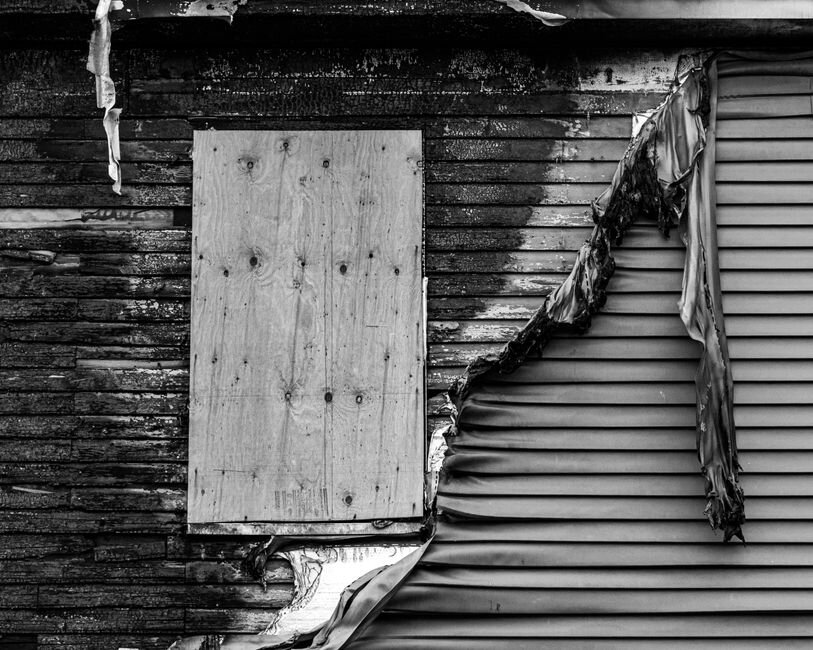
There’s the burn itself, which is usually the most visible and frequently the most contained. There’s smoke, which travels through the entire structure, gets into HVAC ductwork, insulation, and drywall, and produces an odor that survives more remediation attempts than you’d expect. And there’s water damage from putting the fire out, which on an older house can be the largest number of the three.
That last one catches people. The fire department’s job is to stop the fire, not to protect your flooring. A kitchen fire that burned one wall can mean water through the subfloor across half the house.
Then there’s the structural question, which requires somebody qualified. Heat compromises framing and roof trusses in ways that aren’t visible, and no buyer’s lender is closing without that assessed.
The insurance decision
You’ve got a real choice and it’s worth thinking through rather than defaulting.
Filing gets you money to repair. It also puts a claim on the property’s history, and in Florida that follows the house. A property with fire claim history is harder to insure afterward, which means harder for your buyer to insure, which means harder to finance. The Florida Office of Insurance Regulation is worth reading on how carriers are currently treating claim history and older roofs, because both come up.
Check your deductible before you assume filing is obvious. And understand the difference between actual cash value and replacement cost coverage, because on a house built around the town’s median year of 1974, depreciation on a forty-year-old roof can make an actual cash value payout considerably smaller than the repair estimate.
The trap: half-repairing it
This is where people lose the most money, and it happens with good intentions.
You file, you get a partial payout, you do some of the work, and then you try to sell mid-repair. That house is close to unfinanceable. An appraiser sees unfinished work. A lender sees an open claim. An insurer sees a risk they’d rather not write. Your buyer pool collapses to cash, which is where you were before you spent the money.
Either commit to a full restoration with a proper contractor and a permit, or sell it in the condition it’s in. The middle is the expensive place.
Permits, and which office
Fire repair is permitted work, and where you file depends on which side of the line you’re on.
Inside the incorporated Town of Orange Park, that’s the town. In Bellair, Lakeside, Oakleaf, and most of the area that just has an Orange Park mailing address, it’s Clay County. Sellers call the wrong one constantly and lose a week finding out.
If you’re outside the town limits, Clay County’s planning FAQ is where the permitting requirements live. Get the permit properly and get it closed out with a final inspection. An open permit from fire repair is worse than no repair at all from a title perspective, because it sits attached to the property and a buyer’s title work will find it.
What happens to your insurance afterward
Worth understanding before you decide anything, because it affects both what you can do with the house and what a buyer can do.
Claim history follows the property. A carrier looking at a house with a fire claim prices that risk, and some decline it outright. Which means your buyer may find coverage harder to get and more expensive, and no binder means no loan regardless of how much they want the place.
You may also face non-renewal on your own policy. If that happens, read the letter carefully, because the stated reason determines what you can do about it. Roof age has a specific remedy under Florida rules. Claim history generally doesn’t.
And do not let coverage lapse while you’re sorting through all this. An uninsured fire-damaged house is a catastrophic exposure, and if anything else happens to it you have no path back. If you own it with a mortgage, your lender can force-place coverage at a price you’ll hate, and that gets added to what you owe.
What a restored house is actually worth
Less than an identical house that never burned, even after a complete, permitted, professional restoration. That’s not fair and it’s true.
Buyers discount fire history. Insurers price it. And you have a disclosure obligation about it regardless, since Florida expects a seller to disclose known material defects that aren’t readily observable. Fire history qualifies, and it doesn’t stop being true because the drywall is new.
So when you’re deciding whether to restore, price the restored house honestly rather than assuming it returns to full market value. It usually doesn’t.
Your two real options
Full restoration makes sense when the damage is contained, your insurance is covering most of it, you have somewhere to live while it happens, and you have the patience for contractors and inspections. Some people do this and come out fine.
Selling as-is makes sense in most other cases, and it isn’t the consolation prize here. A cash buyer prices the fire damage, the smoke, the water, and the open claim as inputs rather than as reasons a loan gets denied. There’s no appraiser to satisfy, no insurance binder to obtain, and no financing to collapse at week five.
After six years and well over a hundred houses, fire damage is one of the few categories where I’d say the direct sale wins for most people most of the time. The repair path is long, the insurance math frequently disappoints, and the finished house carries a discount anyway.
We Buy Houses Orange Park buys fire-damaged houses, including ones with open claims and tarps still on them. If the fire came from a tenant situation, that side has its own considerations, and if you’re weighing repair costs generally, this covers which problems actually stop a sale.
Josiah Murdaugh grew up in Orange Park and spent 11 years as a licensed real estate agent before he started buying houses directly. He has bought more than a hundred since. About We Buy Houses Orange Park.